Sapa Local Guides · Vietnam · August 2026
Black Hmong People of Sapa — Culture, Indigo Dyeing, Villages & Rice Terraces
Who Are the Black Hmong?
The Black Hmong — Hmong Den in Vietnamese — are the largest ethnic minority group in the Sapa region of Lao Cai Province, northwest Vietnam. They belong to the broader Hmong (Miao) language family, whose communities extend across southern China, northern Vietnam, Laos, and Thailand. In Sapa, Black Hmong families form the most visible presence on upper valley trekking routes, at town markets, and among the local guides who lead walks through the Hoang Lien Mountains.
The name "Black Hmong" refers to indigo-dyed clothing that appears deep blue-black — the everyday dress tradition that distinguishes this subgroup from other Hmong branches in the region, such as Flower Hmong communities found elsewhere in northern Vietnam. Black Hmong identity is expressed through textile production, agricultural labour on steep slopes, livestock management, and oral histories tied to specific valleys and ridgelines beneath Fansipan.
Black Hmong is not a single village or clan. Multiple lineages, dialect variations, and settlement histories exist across the Sapa basin and neighbouring valleys. What unites them geographically is strong association with the upper Muong Hoa Valley — particularly Lao Chai and Y Linh Ho — and with quieter hamlets on the western Hoang Lien flanks such as Sin Chai.
For travellers, understanding who the Black Hmong are converts a terrace photograph into cultural context. The paths you walk, the indigo cloth drying on porches, and the guides interpreting mountain weather are part of a living community — not a historical exhibit.
For broader trip planning — transport, seasons, homestays, budget, and how ethnic groups connect across Sapa — see The Complete Sapa Travel Guide, Sapa Budget & Daily Travel Costs, and What to Pack for Sapa.
History and Origins
Hmong-speaking peoples have inhabited the highlands of southern China and mainland Southeast Asia for centuries. Oral histories and migration narratives among Black Hmong communities in Sapa describe movement from higher plateaus into the terraced valleys of Lao Cai Province — driven by land availability, political change along borders, and access to reliable water for wet rice cultivation.
French colonial administrators documented Hmong settlements around Sapa in the early twentieth century, noting terrace agriculture, opium cultivation in some periods, and distinct clothing traditions. The Sapa hill station developed partly because colonial officials valued mountain climate and views; Hmong families already farmed the slopes above what became the town market.
The twentieth and twenty-first centuries brought roads, schooling in Vietnamese, fixed national borders, and tourism growth that reshaped economic life without erasing textile skills, farming calendars, or spiritual practice. Many Black Hmong families now combine agriculture with income from guiding, homestays, and craft sales — a dual economy familiar across ethnic minority regions of Vietnam.
Relations with neighbouring groups — Giay communities in lower Muong Hoa, Red Dao families on forested side valleys, Tay settlements in river corridors — involve trade, intermarriage, shared market days, and distinct land-use patterns at different elevations. The Sapa region is multi-ethnic by geography, not by assimilation into a single culture.
Where Black Hmong Communities Live
Black Hmong settlements concentrate where terrace agriculture and pasture land overlap — mid-elevation slopes with reliable water, forest access for firewood and forage, and footpath connections to town markets.
Lao Chai
Lao Chai is one of the largest Black Hmong villages in Muong Hoa Valley and a natural crossroads on many trekking routes. Terraces unfold toward the river from paths above the village; daily life centres on farming, livestock, and textile work between houses scattered along hillsides. Lao Chai sees significant trekking traffic because it sits on the popular valley loop — arriving early in the day, as private tours typically do, changes how crowded paths feel.
Y Linh Ho
Y Linh Ho sits above some of the steepest terrace walls in the upper valley — often the first Black Hmong settlement trekkers reach when descending from Sapa. Houses spread along ridges rather than clustering in a single centre, producing a quiet, panoramic atmosphere compared with busier stops further downstream. Y Linh Ho represents upper-valley Black Hmong life at its most visually dramatic: vertical terraces, wide sky views, and footpaths linking scattered households.
Beyond Muong Hoa
Black Hmong hamlets extend beyond the famous valley loop. Sin Chai, on the western edge of the Hoang Lien range, is a traditional Black Hmong village reached on remote multi-day routes — higher, quieter, and far from the busiest day-trek corridors. Suoi Ho and Ma Tra, visited on the Sapa Countryside Walking Tour, illustrate how Black Hmong families also live within walking distance of Sapa Town itself, farming terraces and gardens on the town's rural fringe. Cat Cat Village is another near-town Black Hmong settlement — a ticketed stream-and-waterfall site just below the hotel district, geographically separate from both Muong Hoa and the countryside-walk hamlets.
Settlement elevation affects daily rhythm. Upper villages experience cooler nights, earlier mist, and shorter growing seasons than lower Giay or Tay communities in the same watershed. Understanding where Black Hmong villages sit relative to Muong Hoa Valley geography helps interpret cultural and agricultural differences on a single day's walk downhill.
Traditional Houses and Villages
Black Hmong homes in the Sapa region are predominantly wooden structures built on hillsides — post-and-beam frames with metal or tile roofs on most modern buildings, though older thatch-roofed examples persist in remoter hamlets. Village layout tends toward dispersion: houses on ridges and terrace brows rather than compact grids, reflecting land ownership patterns and access to fields.
A typical home centres on a main room with a cooking fire — heat source, meal preparation, and evening gathering space combined. Sleeping areas may be partitioned or on raised platforms. Livestock pens for pigs and poultry often sit adjacent to or beneath living quarters, practical for mountain winters and predation risk.
Homestay accommodation for travellers uses the same buildings — simple mattresses, blankets, shared facilities — within working households rather than purpose-built lodges. That distinction matters for respectful expectations: guests are received in family space, not hotel space.
Village paths are shared infrastructure — connecting houses, fields, schools, and water sources. They are not tourism corridors alone. Children walk them daily; farmers haul fodder and timber along them; guides and guests pass through as temporary visitors. Speed, noise, and litter on these paths affect residents long after tour groups leave.
Indigo Dyeing and Traditional Clothing
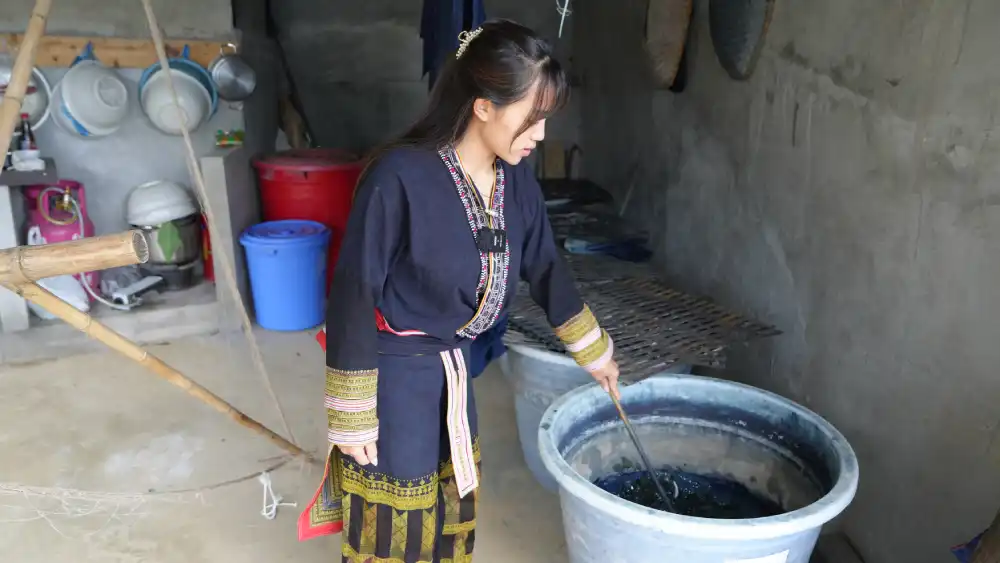
Black Hmong textile tradition is among the most recognisable material cultures in Southeast Asian tourism — and among the most technically demanding. Clothing identity depends on indigo dye, hemp fibre, and hand-woven cloth produced through processes that take weeks or months per garment.
Hemp and weaving
Hmong families traditionally grow or source hemp, retting and pounding fibres into thread, then weaving cloth on household looms. The rhythm is seasonal — planting and harvest work interrupt textile production — but cloth preparation remains a core household skill, passed from elders to younger generations.
Indigo dyeing
Indigo dye produces the deep blue-black tones that give Black Hmong their name. Dye vats ferment indigo paste in alkaline solution; cloth is dipped repeatedly, oxidising between immersions until the desired darkness is achieved. Fresh indigo dyeing smells sharp and organic; vats near village homes signal active textile work.
Indigo is not merely colour — it marks clothing identity, age status, and occasion. Festival dress differs from daily work clothes; wedding and funeral garments carry obligations of preparation that commercial tourism rarely sees.
Silver jewellery and accessories
Women often wear large silver earrings, necklaces, and decorative panels — purchased, inherited, or collected over years. Silver carries wealth display and aesthetic tradition simultaneously. Photographing jewellery without engagement or permission reduces people to costume.
The Sapa Indigo Heritage Experience offers a structured introduction to indigo dyeing and hemp textile craft with Hmong artisans — hands-on learning distinct from brief trail-side glimpses. The Sapa Countryside Walking Tour includes visits to Black Hmong family homes where indigo and weaving continue as daily practice rather than staged performance.
Rice Terrace Farming
Rice terraces define the landscape of Black Hmong settlement zones — engineered slopes holding water for wet rice cultivation across seasons. These rice terraces are livelihood infrastructure, not scenic backdrops. Families maintain stone and earth embankments, manage shared irrigation channels, and transplant seedlings in rhythm with monsoon timing.
Seasonal cycle
Planting season floods terraces with mirror-bright water. Green season fills slopes with young rice. Golden season precedes harvest, when grain dries on racks near houses. Winter terraces may lie fallow or hold secondary crops — corn, vegetables, or rest periods for soil recovery.
Terrace repair is constant work. Landslides, buffalo damage, and heavy rain destroy embankments that require days of collective or family labour to rebuild. Tourism income supplements farming but rarely replaces it as the primary livelihood for most Black Hmong households in the Sapa region.
Livestock integration
Water buffalo plough terraces where mechanisation cannot reach. Pigs and poultry provide protein and market income. Goats and cattle graze hillside pasture between forest margins and field edges. Livestock management shapes daily schedules — feeding, herding, veterinary care — visible to trekkers who walk village paths at the right hours.
Cutting across planted fields, dislodging embankment stones, or flying drones low over working farmers shows disregard for the labour embedded in every curved wall.
Family and Daily Life
Black Hmong family structure traditionally emphasises extended household cooperation — grandparents, parents, and children sharing agricultural tasks, childcare, and textile production. Gender roles remain visible in daily division of labour, though tourism and schooling have introduced new employment patterns, especially for younger women and men working as guides or homestay hosts.
Children attend village schools when accessible, often walking significant distances on mountain paths. School schedules interact with tourism — a tension in communities where children selling bracelets on trails generates income but raises education concerns that responsible operators avoid encouraging.
Elders hold knowledge of herbal plants, oral histories, textile patterns, and ritual practice. Younger generations may migrate seasonally or permanently to towns and cities, sending remittances while reducing village labour available for terrace maintenance.
Meals centre on rice, vegetables, pork, and foraged greens — home cooking over fire rather than restaurant service on typical homestay nights. Guests who accept food offerings engage a hospitality tradition; guests who treat meals as insufficient relative to urban standards misunderstand the context.
Many Sapa Local Guides trekking guides are Black Hmong and grew up on these trails — interpreting weather, village customs, and trail conditions from lived experience. That employment path represents one way tourism integrates into family economies without replacing farming entirely.
Festivals and Beliefs
Black Hmong spiritual life combines ancestor veneration, spirit appeasement at household altars, and calendar festivals tied to agricultural cycles. Practices vary between villages and clans; outsiders should assume ceremonies are private unless a host family explicitly invites observation.
New Year celebrations — aligned with lunar calendar traditions shared across Hmong communities in the region — involve special foods, ceremonial dress, ancestor offerings, and social visiting between households. Weddings require extended negotiation between families, embroidered garments, and ritual specialists. Funerals follow protocols for guiding the deceased and supporting mourners over days or weeks.
Spirit beliefs attach to natural features and domestic spaces — forest taboos, water sources, threshold rituals — reflecting a worldview in which landscape and household are spiritually active. Disrespect at sacred sites, intrusive photography during rituals, or loud behaviour at ceremonies causes genuine offence.
Travellers rarely plan visits around Hmong festivals unless homestay arrangements are made through operators with village relationships. If you witness festival preparation, observe quietly and follow your guide's or host's guidance.
Responsible Cultural Tourism
Tourism has brought income, employment, and visibility to Black Hmong communities — alongside pressure: trail crowding on the Lao Chai–Ta Van loop, children encouraged toward bracelet-selling rather than school, cultural simplification for market photography, and uneven benefit distribution when intermediaries absorb homestay payments.
Practices that support Black Hmong communities rather than extract from them:
- •Book private tours with local guides employed directly — not anonymous mass groups
- •Buy textiles and crafts from makers at fair prices; avoid aggressive bargaining on handmade work
- •Ask permission before photographing people, especially children and ceremonial dress
- •Stay on established paths; do not enter homes uninvited
- •Carry out all litter; do not distribute candy or money to children on trails
- •Choose experiences that explain culture rather than commodify it — such as the Sapa Indigo Heritage Experience or guided walks through Sapa Trekking Tours with English-speaking local guides
Sapa Local Guides operates with a minimum of two paying travellers, working through personal relationships with Black Hmong, Red Dao, Tay, and Giay families. Custom cultural routes — extended homestays, multi-village combinations, or quieter hamlets — can be arranged through Private Sapa Expeditions.
Compare cultural context with the Red Dao people guide to understand how neighbouring groups maintain distinct identities while sharing the same mountain landscape.
Visiting Black Hmong Villages Respectfully
Respect converts ethical intention into behaviour on the ground.
Prepare before walking
Read the Muong Hoa Valley guide to understand how Lao Chai, Y Linh Ho, and neighbouring villages fit into trekking geography. Read the Hoang Lien Mountains guide for elevation, weather, and landscape context. Knowing where you are prevents treating villages as interchangeable photo stops.
On the trail
Walk at village pace when passing houses and school paths. Greet adults briefly; follow your guide's lead on language and customs. Dogs guard properties — give space and avoid sudden movements. Buffaloes on paths have right of way; wide berths prevent accidents.
If invited for tea or a meal, accept or decline graciously. Remove shoes when entering homes if residents do. Do not assume open terraces or doorways invite entry without invitation.
Photography and commerce
Portrait photography of residents — especially women in traditional dress — should follow explicit permission. Craft purchases support household income more reliably than tips or unsolicited gifts. Haggling over embroidered work that took weeks to produce undervalues labour.
What Sapa Local Guides offers
Sapa Local Guides provides private trekking through Black Hmong territory — valley routes on Sapa Trekking Tours, gentler town-fringe walks on the Sapa Countryside Walking Tour, and dedicated textile learning on the Sapa Indigo Heritage Experience. We do not treat Black Hmong villages as open-air museums; guides facilitate introductions, translate conversations, and manage logistics while families continue daily life around guests.
Frequently Asked Questions
How many Black Hmong people live around Sapa?
Population figures vary by census boundaries and administrative definitions. Black Hmong communities are distributed across multiple communes in Lao Cai Province — concentrated in Muong Hoa Valley and on Hoang Lien slopes — rather than living in a single town. For travellers, their presence is substantial and visible across most standard trekking routes.
Why are they called Black Hmong?
The name reflects indigo-dyed clothing that appears deep blue-black — the everyday dress tradition distinguishing this Hmong subgroup from others in the region with different colour palettes and textile styles.
What is the difference between Black Hmong and Red Dao?
Both are ethnic minority groups in the Sapa region with distinct languages, clothing, and settlement patterns. Black Hmong identity centres on indigo hemp dress and upper Muong Hoa valley presence; Red Dao identity centres on red headdresses and elaborate embroidery, with villages such as Giang Ta Chai and Ta Phin. Neighbouring does not mean interchangeable — see the Red Dao people guide for comparative context.
Which villages should I know?
Lao Chai and Y Linh Ho are the most frequently visited Black Hmong settlements on Muong Hoa trekking routes. Sin Chai represents quieter, higher Black Hmong country on remote ridge walks. Suoi Ho and Ma Tra lie near Sapa Town on countryside walking paths.
Can I learn about indigo dyeing without a multi-day trek?
Yes. The Sapa Indigo Heritage Experience focuses specifically on textile craft with Hmong artisans. The Sapa Countryside Walking Tour visits a Black Hmong family home where indigo and weaving form part of daily life.
Is it appropriate to buy Hmong textiles in Sapa Town markets?
Many market vendors are producers or family representatives — purchasing directly supports household income. Ask about the work when conversation allows; distinguish handmade pieces from mass-produced imitations when possible.
Do Sapa Local Guides employ Black Hmong guides?
Many Sapa Local Guides trekking guides are Black Hmong and grew up on Hoang Lien trails. Guide assignment depends on availability, language skills, and route requirements.
How do Black Hmong communities relate to Fansipan and the Hoang Lien range?
Black Hmong families farm and forage on lower and mid-elevation slopes of the Hoang Lien Mountains — terrace agriculture in valleys, livestock on forest margins, with Fansipan as the geographic summit above their daily landscape rather than a routine destination.
The Black Hmong people are central to Sapa's cultural identity — their indigo cloth, terrace labour, and village paths predate tourism and will outlast any travel trend. Visiting with respect, learning before photographing, and choosing operators who employ local families turns a walk through Muong Hoa into something closer to genuine cultural understanding.
Place authority guides
Lao Chai · Y Linh Ho · Sin Chai · Suoi Ho · Ma Tra · Cat Cat Village
Ready to book?
Ready to book? Explore our Book Sapa indigo workshop tour.
¿Quieres crear tu propia historia?
Únete a un trek u homestay en Sapa y vive la verdadera montaña.
Consultar por WhatsApp