Sapa Local Guides · Vietnam · August 2026
How to Get from Hanoi to Sapa — Trains, Buses, Limousine & Travel Times
Introduction
How do you get from Hanoi to Sapa? Most international travellers start in Hanoi — Vietnam's capital at low elevation and hot summers — and need to reach Sapa Town, a hill station at roughly 1,500 metres in Lao Cai Province, looking out over Muong Hoa Valley and the Hoang Lien Mountains. The journey is not complicated, but options differ sharply in comfort, timing, cost, and how much sleep you lose before a trekking day.
This guide explains transport choices in planning terms — not as a booking sales page. Sapa Local Guides trekking and homestay products start in Sapa Town itself; transport from Hanoi to Sapa is your own arrangement and is not included in tour prices on this site. Plan to arrive the day before an early-morning trek — most full-day routes depart around 08:30 from Sapa Stone Church on Fan Si Pan Road.
For seasons, how many days to stay, budget, packing, and what to do once you arrive, see The Complete Sapa Travel Guide, Best Time to Visit Sapa, How Many Days Do You Need in Sapa, Sapa Budget & Daily Travel Costs, and What to Pack for Sapa.
Distance Between Hanoi and Sapa
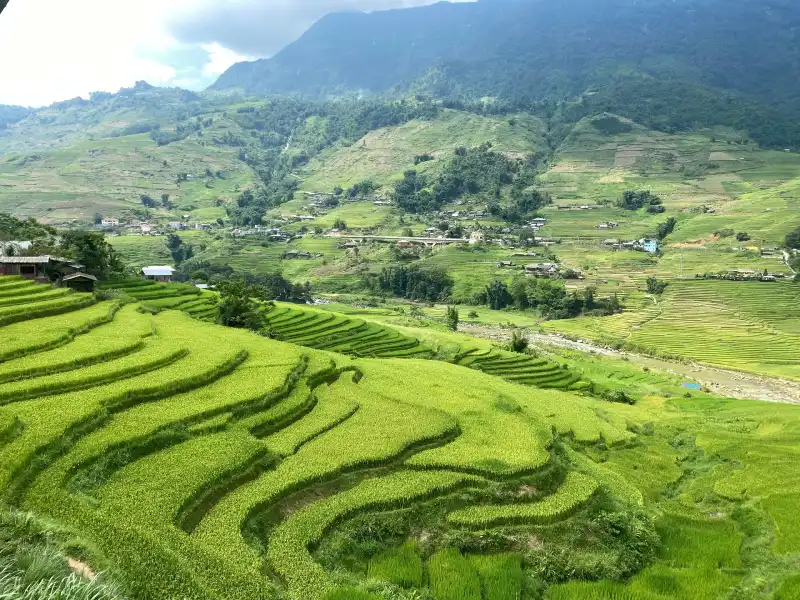
Road distance from central Hanoi to Sapa Town is roughly 320 kilometres — southeast to northwest, climbing from the Red River Delta into mountain country near the China border. Lao Cai city sits at the base of the ascent; Sapa perches on the basin rim above the valleys where Fansipan dominates the western skyline.
Elevation gain matters as much as distance. Hanoi at near sea level to Sapa at ~1,500 metres means cooler air on arrival, winding mountain roads on the final approach, and weather that may differ from what you left in the capital. The last hour from Lao Cai to Sapa is uphill on Highway 4D — slow behind trucks, misty in rain, dramatic in clear light.
No airport serves Sapa directly for commercial flights. All routes from Hanoi are overland — train plus transfer, bus, van, or private car.
Overnight Sleeper Buses
Direct overnight sleeper buses run from Hanoi to Sapa Town — the most common budget approach for travellers who want to wake up in the mountains without managing a train connection.
Typical pattern: depart Hanoi Old Quarter or designated pickup points between 21:00 and 22:30; arrive Sapa 05:00–07:00 depending on traffic and road works. Journey time roughly six to seven hours on the direct route.
What to expect: Reclining berths in a shared cabin — narrower than a train sleeper, more vibration on mountain curves. Toilet stops at rest areas. Some services drop at Sapa bus station; others stop near the town centre — confirm when booking.
Planning notes:
- •Book through reputable operators — quality varies significantly between companies
- •Bring earplugs, warm layer, and charged phone — early arrival before hotel check-in is normal; many hotels store bags if rooms are not ready
- •Motion sickness sufferers may prefer train or private car
- •Not ideal if you need reliable sleep before a same-day trek — arrive the night before your tour regardless
VIP Cabin Buses
VIP cabin buses upgrade the overnight bus model — fewer berths per cabin, sometimes wider beds, charging ports, and blanket provision. Same direct Hanoi–Sapa routing as standard sleepers with modest comfort improvement.
Travel times remain six to seven hours. Price sits above standard sleepers but well below private transfer. Useful for travellers who want bus convenience without the most cramped berths.
Verify cabin layout photos when booking — "VIP" labelling is not standardised across operators. Read recent reviews for cleanliness and punctuality. Early-morning arrival dynamics match standard buses: plan hotel bag drop or late check-in accordingly.
Limousine Vans
Limousine vans — shared or semi-private nine- to eleven-seat vehicles — run daytime and overnight schedules between Hanoi and Sapa. Faster than full-size buses on some departures; more expensive than standard sleepers.
Daytime limousines suit travellers who prefer to see the landscape and arrive before evening — useful if you want a settled night in Sapa before trekking. Overnight limousines compete with sleepers on time but offer seated or reclining leather seats rather than flat berths — preference varies by traveller.
Pickup often from Hanoi Old Quarter hotels; drop-off in Sapa town centre or agreed hotel zone. Journey time roughly five to six and a half hours in good conditions — traffic and the Lao Cai–Sapa climb add variability.
Good middle ground for couples or small groups wanting more comfort than a standard bus without private car cost.
Train to Lao Cai + Transfer to Sapa
The overnight train from Hanoi to Lao Cai remains the classic route — not because it is always fastest, but because it offers relative comfort, safer night travel on a fixed rail line, and arrival at Lao Cai city in the early morning ready for the uphill transfer.
Pattern: Evening departure from Hanoi (Gia Lam or Hanoi station depending on service); early-morning arrival Lao Cai roughly eight to nine hours rail time. From Lao Cai station, Sapa Town is about one hour uphill by shared minibus, hotel shuttle, or taxi on Highway 4D.
Sleeper classes: Hard sleeper (six-berth compartment), soft sleeper (four-berth), and occasional VIP or luxury carriages on tourist-oriented services — price and comfort scale accordingly. Book ahead in peak season (September–October golden rice weeks).
Lao Cai transfer options:
- •Shared minibus from station area — wait until full or pay per seat
- •Pre-arranged hotel pickup — confirm cost when booking accommodation
- •Taxi or Grab — flexible but more expensive for solo travellers
Train travellers often enjoy the approach into Lao Cai at dawn — low mist over the Red River valley before the mountain climb. Once in Sapa, connect trekking plans to Muong Hoa Valley routes via Sapa Trekking Tours.
Private Car
Private car hire from Hanoi to Sapa offers door-to-door flexibility — hotel pickup in Hanoi, drop at your Sapa accommodation. Travel time roughly five to six hours in daylight without long stops; drivers familiar with mountain roads handle the Lao Cai–Sapa section.
Best for families with children, groups splitting cost, travellers with heavy camera gear, or tight schedules requiring a specific arrival window. More expensive than public transport but eliminates station transfers and fixed bus timetables.
Daytime private transfer allows same-day arrival with afternoon free in town — still allow recovery before an early trek departure. Overnight private hire is uncommon; most travellers choose train or bus for night travel unless budget is unrestricted.
Custom multi-stop itineraries — Hanoi to Sapa with village visits en route — can be discussed through Private Sapa Expeditions for in-destination trekking; Hanoi–Sapa car booking remains separate unless arranged through your hotel or a transport agent.
Self-Driving and Motorbike Considerations
Self-driving a rental car from Hanoi to Sapa is legal for holders of appropriate Vietnamese licences or international permits accepted in Vietnam — but mountain roads demand caution. Highway 4D from Lao Cai to Sapa is winding, often foggy, shared with heavy trucks, and slick in rain.
Motorbike travel attracts experienced riders — multi-day Hanoi to Sapa rides via northwest highlands appeal to adventure motorcyclists. Not recommended for first-time Vietnam riders or wet-season travel without local escort knowledge.
Practical constraints:
- •Parking in Sapa town centre is limited; hotels may offer motorbike parking
- •Theft and damage insurance on rentals — verify coverage before long mountain routes
- •Fatigue after overnight bus is safer than fatigued self-drive on descent
- •Weather changes quickly — visibility drops on 4D without warning
Most trekking guests do not self-drive; they walk valleys such as Muong Hoa Valley on foot with guides after arriving by train or bus.
Which Option Is Best for Different Travellers
Budget backpacker: Overnight sleeper bus or hard sleeper train — lowest cost; accept sleep trade-off.
Couple wanting comfort: Soft sleeper train or VIP bus — better sleep than cramped bus berths.
Family with children: Private car daytime — schedule control, no station chaos.
Photographer with gear: Private car or soft sleeper — protect equipment; arrive rested.
Short time (one night): Overnight bus or train — wake in Sapa; trek next morning.
Motion sickness prone: Train to Lao Cai — less winding until final hour by road.
First visit to Vietnam: Train plus transfer or reputable limousine — predictable; easier to navigate.
None of these options includes Sapa Local Guides trekking — book transport and tours separately. Minimum two paying guests on private treks; meet at Sapa Stone Church before valley walks toward Muong Hoa Valley.
Travel Times
Summary of typical door-to-door durations — verify with operators; road works and weather add variance.
Direct overnight sleeper bus: Depart Hanoi 21:00–22:30; arrive Sapa 05:00–07:00 next day — typically 6–7 hours.
VIP / cabin overnight bus: Similar evening departure; early-morning arrival — 6–7 hours.
Daytime limousine van: Depart 07:00–14:00; arrive same day afternoon or evening — 5–6.5 hours.
Train plus Lao Cai transfer: Evening departure ~21:00–22:00; Lao Cai ~05:00–06:30; Sapa ~06:30–08:00 — 9–10 hours total.
Private car (daytime): Flexible departure; same-day arrival — 5–6 hours.
Plan buffer time before tour start — shower, breakfast, and acclimatisation to mountain air improve first trekking days in Hoang Lien Mountains foothills.
Return journeys mirror outbound options — many travellers take train from Lao Cai after a final night in Sapa, or book afternoon bus south to Hanoi after a morning half-day walk.
Approximate Costs
Prices change by season, operator, and booking channel. Figures below are planning estimates in USD per person one-way (August 2026 research range) — confirm before travel.
- •Standard overnight sleeper bus: $12–20 — book via hotel or online agent
- •VIP cabin bus: $18–28 — fewer berths, variable quality
- •Daytime or overnight limousine: $15–30 — shared van; higher end for fewer seats
- •Train hard sleeper Hanoi–Lao Cai: $15–22 — plus transfer below
- •Train soft sleeper: $25–40 — book ahead in peak season
- •Lao Cai–Sapa shared transfer: $3–8 — wait for fill or pay seat rate
- •Lao Cai–Sapa private taxi: $15–25 total — split among group
- •Private car Hanoi–Sapa (whole vehicle): $120–180 — divides across passengers
Payment in Vietnamese dong is standard locally. International cards work on some booking platforms; cash USD or dong often required at stations.
Sapa Local Guides tour prices on this site are quoted in euros and exclude Hanoi–Sapa transport — budget separately.
Arrival Timing and First-Day Planning
Choose transport by the morning you need after arrival, not only by the ticket price. A sleeper bus or overnight train can preserve a daytime schedule but may leave you in Sapa before a room is ready. A daytime limousine or private car gives a settled arrival but uses part of the day. The useful question is whether your group will be rested enough for the next planned activity.
For a valley trek, protect the night before the roughly 08:30 meeting. Do not treat a 05:00–07:00 bus arrival as equivalent to a proper recovery night, especially for children, older travellers, or anyone prone to motion sickness. Use the arrival day for bag drop, breakfast, town orientation, or rest when the schedule is tight.
Common itinerary mistakes are booking the only walking day immediately after an overnight journey, putting Fansipan and a full valley trek into the same arrival window, and forgetting the Lao Cai-to-Sapa transfer after a train. Build the route in layers: reach Sapa, settle in, keep one clear walking identity, and leave enough time for the return journey. Transport convenience cannot remove mountain weather, road delays, or trail fatigue.
Frequently Asked Questions
What is the best way to get from Hanoi to Sapa?
There is no single best way — overnight train to Lao Cai suits travellers prioritising sleep quality; direct sleeper buses suit budget and simplicity; private cars suit families and fixed schedules. All require planning for early-morning tour starts in Sapa.
How far is Hanoi from Sapa?
Roughly 320 kilometres by road. The final hour from Lao Cai climbs steeply to Sapa Town at ~1,500 metres.
Can I do a day trip from Hanoi to Sapa?
Technically possible via very early private car or late-night bus, but not recommended for trekking-focused visits. Mountain walks in Muong Hoa Valley deserve at least one overnight in Sapa — see Best Time to Visit Sapa for planning length.
Does the train go directly to Sapa?
No. Trains terminate at Lao Cai city. You need a road transfer of about one hour to Sapa Town.
Is the overnight bus safe?
Reputable operators run daily with reasonable safety records, but road conditions and driver fatigue remain factors on mountain highways. Choose established companies with reviews; train travel avoids the steepest winding section at night.
When should I arrive before a trek?
The day before your trekking date. Most Sapa Trekking Tours depart around 08:30. Overnight transport arriving 05:00–07:00 allows rest and breakfast before walking.
Is transport included in Sapa Local Guides tours?
No. Transport from Hanoi to Sapa and return is your arrangement. Some treks include within-Sapa transfers — for example private car from Ta Van back to town after a valley day — but not inter-city travel from Hanoi.
Can I combine Fansipan cable car on arrival day?
Possible if you arrive early by train or bus and accept fatigue — summit weather is independent of travel timing. See the Fansipan guide for seasonal visibility; most travellers schedule cable car on a separate half-day after a full night's rest.
How do I return from Sapa to Hanoi?
Same options in reverse — afternoon or overnight bus from Sapa town, private car daytime, or minivan to Lao Cai for evening train. Book return before peak weekends and October harvest season.
Getting from Hanoi to Sapa is the threshold between capital-city travel and mountain trekking — choose transport that leaves you rested enough to walk Muong Hoa Valley with attention, not exhaustion. Plan arrival, season, budget, and tour dates together — see How Many Days Do You Need in Sapa and Sapa Budget & Daily Travel Costs. The mountains above Fansipan reward travellers who arrive prepared rather than rushed.
Envie de créer votre propre histoire ?
Rejoignez un trek ou un homestay à Sapa et vivez la vraie montagne.
Demander sur WhatsApp