Sapa Local Guides · Vietnam · August 2026
Sapa Rice Terraces — Seasons, Villages, Photography & How to See Them
Executive Summary
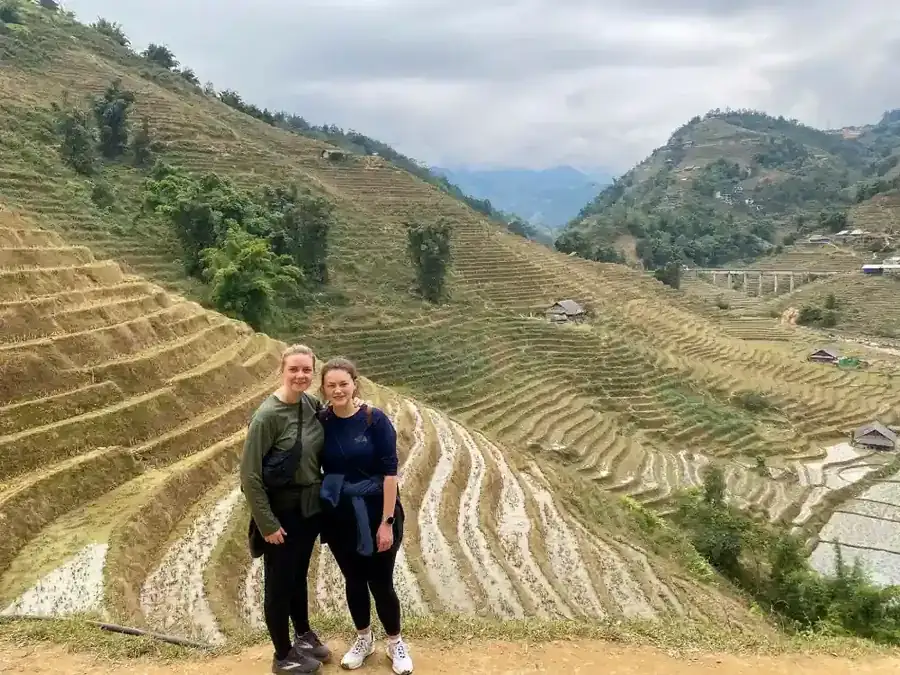
Sapa rice terraces are working wet-rice fields cut into mountain slopes in Lao Cai Province, northern Vietnam — not a single fenced viewpoint. The landscape people search for lives mainly in Muong Hoa Valley: stacked embankments above Y Linh Ho and Lao Chai, softening toward Ta Van. Lower Tay country around Ban Ho holds terraces too, on a different watershed, reached on multi-day walking rather than a town afternoon.
They are famous because scale, inhabited villages, and foot access coincide. They are not the only terraces in Vietnam, and they are not photogenic in every month. Colour follows a crop calendar: flooded planting, green growth, golden grain, then harvest and winter rest. Weather can hide the same slopes in cloud on a “perfect” calendar week.
Where to see them: walk Muong Hoa village paths — not Cat Cat Village, which is a ticketed stream gorge below town. Comparison: Cat Cat vs Muong Hoa Valley. Terraces near town exist at smaller scale on the Sapa Countryside Walking Tour (Suoi Ho, Ma Tra); they are not the Lao Chai amphitheatre.
Which walk: a first terrace day that matches 10–12 km is the Easy Muong Hoa Valley Trek. A longer single day that continues toward Giang Ta Chai is the Full-Day Muong Hoa Valley Trek — more forest and waterfall, not a bigger terrace stadium. Month-by-month climate: Best Time to Visit Sapa.
What Are Sapa Rice Terraces?
Sapa rice terraces are stepped wet-rice paddies maintained by ethnic-minority farming households — chiefly Black Hmong on upper Muong Hoa slopes, Giay on lower riverside benches, and Tay families in lower valleys such as Ban Ho. Stone and earthen walls hold water for transplanting, then drain as grain matures. Irrigation uses streams and shared channels. Water buffalo still plough where machines cannot.
The system is old in the sense of generations of repair, not a monument built once and left. Each curve of wall is slightly different because the slope is different. That irregularity is why the fields photograph as a living surface rather than a grid.
They are livelihood infrastructure. Cutting across a planted terrace, dislodging stones, or blocking a channel costs a household crop. Tourism shares the same paths farmers use to reach fields and school. Treating the landscape as a backdrop is the main visitor error.
Sapa Town sits near 1,500 metres on the Hoang Lien Mountains rim. Terraces fall away into valleys; they are not a park at the hotel door. For trip structure see The Complete Sapa Travel Guide and How Many Days Do You Need in Sapa.
Why They Are Famous
Search results repeat “most beautiful rice terraces” until the phrase is empty. The verifiable reasons Sapa’s fields travel well in photographs and in trek itineraries are narrower:
- •Scale in one corridor. Muong Hoa concentrates a large, walkable terrace amphitheatre within a day’s descent from town.
- •People in the frame. Houses, buffalo, and field work sit on the same slopes. The landscape is inhabited.
- •Access. Guided village trails reach the walls without a remote expedition.
- •Seasonal colour. Water, green, and gold are real phases — not filters — when the crop cooperates and the cloud lifts.
They are not famous because they are empty wilderness, guaranteed gold in October, or visible from every café in town. Winter mist, wet-season mud, and bus-tour hours on Lao Chai paths are part of the same place.
Green Season
Green season is young rice covering the slopes — typically June through August in the Muong Hoa calendar used across these guides. Fields look lush. It is also the wettest window: slick paths, low cloud, Fansipan often wrapped, afternoon rain.
What you get: emerald intensity, dramatic mist when it clears, fewer international visitors than October. What you do not get: reliable long views or dry boots. Waterproof footwear is not optional. July and August are among the hardest months for visibility and stone-path traction.
Green is not “better” than gold. It is a different crop phase. Photographers who need clear ridgelines should not plan around July because a blog called the terraces emerald.
Golden Season
Golden season is the pre-harvest colour — grain ripening toward yellow — widely late September through October on upper Muong Hoa slopes, with November still gold on some benches while others are already cut. This is the classic Sapa photography window and the busiest international period.
Clearer skies return more often than in summer. Comfortable walking temperatures are common. Paths above Lao Chai and Y Linh Ho carry more groups at mid-morning. Book private walking days and homestays early if those dates are fixed.
Golden colour is not simultaneous across every elevation. Ban Ho, lower and warmer, can sit on a slightly different week than Y Linh Ho. A “golden season Sapa” search result that names a single weekend for the whole district overstates the agriculture.
Harvest Season
Harvest is labour, not only colour. Families cut rice, thresh, and dry grain near houses. Timing overlaps the end of the golden window and runs into November depending on slope, seed, and rain.
During harvest, terraces may look patchwork: gold, cut stubble, and drying racks in the same view. That is the honest picture of a working valley. Stay off drying grain and out of fields being cut. Paths can be busier with household traffic, not only trekkers.
Harvest is worth seeing if you want agriculture rather than a uniform postcard. It is a poor week to demand every terrace still be gold.
Planting Season
Planting (late spring into early summer — April into May in the same calendar, with local shift) floods paddies. On clear days the water mirrors sky and cloud. Farmers transplant seedlings. Embankments are wet and easily damaged.
This is one of the strongest photography phases for pattern and reflection — and one of the worst for shortcutting. Mud is deep. Channels are live. March can show early green and more comfortable walking before the heaviest rain; May sits between water and young shoots as wet season builds.
Do not invent a “best planting weekend.” Watch the fields you are actually walking through.
Weather Impact
Terrace colour means little if you cannot see the slope. Sapa weather moves in minutes: mist up from the river, sun on Lao Chai while Ta Van stays in cloud, rain turning paths slick within an hour. Town forecasts understate valley mud and stream levels.
- •Wet season (roughly May–August): lush, low visibility, traction risk.
- •Clearer windows (often March–May and September–November): better long views, still not a guarantee.
- •Winter (December–February): fallow or brown terraces, mist, cold; village atmosphere over panorama.
Guides on Muong Hoa routes decide from trail conditions, not from a generic app. A cancelled or rerouted walking day in heavy rain is safety, not a failed terrace hunt. Packing: What to Pack for Sapa.
Best Months
There is no single best month. Match the month to the question:
| Priority | Typical window (Muong Hoa, used across these guides) | |----------|------------------------------------------------------| | Golden colour | Late September–October; November still mixed | | Green lushness | June–August (accept rain and cloud) | | Planting water / reflections | April–May (local variation) | | Walking comfort + views | March–May and September–November | | Quiet trails, little colour | December–February |
October is the busiest photography month, not a private viewing. March and April often give first-time walkers a better crowd-to-weather ratio than peak gold. Full month notes: Best Time to Visit Sapa.
Best Villages
“Best village for rice terraces” depends on which walls you mean.
- •Most panoramic stacked walls: Y Linh Ho (upper, steep) and Lao Chai (mid-valley amphitheatre).
- •Softer riverside terraces, Giay settlement: Ta Van.
- •Lower-valley, different watershed, Tay country: Ban Ho — not a substitute for Lao Chai on a day trip.
- •Near town, smaller scale: Suoi Ho and Ma Tra on the countryside walk.
- •Not the terrace bowl: Cat Cat Village.
Giang Ta Chai is important for forest and waterfall on longer days; it is not the primary terrace-amphitheatre answer.
Muong Hoa Valley
Muong Hoa Valley is the river corridor east and south of Sapa Town — on the order of fifteen kilometres of inhabited agricultural landscape, not a single named field. Black Hmong, Giay, and Red Dao communities farm and walk it. Most one-day and two-day treks use this corridor.
If a search says “Muong Hoa rice terraces,” this is the place: the amphitheatre walls, the village sequence, the season cycle described above. Cat Cat is a different stream. Ban Ho is further south and lower.
Walking the valley means hours on foot after a trailhead transfer, then usually a vehicle return uphill. That is the cost of seeing the fields at the scale the photographs show.
Lao Chai
Lao Chai is a large Black Hmong settlement on the central Muong Hoa loop. Paths above the village open layered terraces toward the river in the frames most people mean by “Sapa rice terraces.” It is a crossroads: more foot traffic than Y Linh Ho, still farmland.
Water buffalo, school paths, and indigo work share the same trails as trekking groups. Early private starts feel different from midday. Lao Chai appears on both Easy and Full-Day valley products and on multi-day routes. It is the wrong “quiet secret village” and the right “this is the terrace country” village.
Ta Van
Ta Van is the Giay riverside anchor downstream from Lao Chai. Terraces here are broader and less vertical than Y Linh Ho’s walls — bamboo, vegetable gardens, stilt houses, river sound. Many day walks lunch or finish here. Homestays with Giay families sit in this part of the valley.
Photographers who only want the steep amphitheatre may feel Ta Van is “less terrace.” It is a different terrace type, and the cultural shift from Black Hmong upper slopes to Giay riverside life is part of what a Muong Hoa day actually is.
Y Linh Ho
Y Linh Ho is often the first Black Hmong village on a descent from the Sapa basin into Muong Hoa. Houses scatter on ridges above some of the steepest panoramic walls in the valley. Quieter than Lao Chai as a crossroads; still a living farm community.
If the question is “best village for dramatic terrace photography on a first walking day,” Y Linh Ho and the paths between Y Linh Ho and Lao Chai are the usual honest answer — weather permitting. It is a regular opening section of the Easy Trek.
Ban Ho
Ban Ho is not on the main Muong Hoa day-trek loop. It is a lower, warmer Tay riverside commune on a southern watershed, typically reached on foot on a three-day itinerary such as the 3-Day Sapa Valley & Village Trek. Stilt houses, greener walls, fish in the food culture.
Terraces exist and matter to households. Planting and harvest can sit on a different week than Y Linh Ho. Ban Ho is the wrong answer to “rice terraces near Sapa town” and a fair answer to “lower-valley terraces on a multi-day walk.” Do not day-trip it as a Lao Chai substitute.
Photography Guide
Terrace photography here is path photography. The good frames are from established trails above and through Y Linh Ho and Lao Chai, and from broader Ta Van benches — not from walking on planted soil.
- •Season: gold (late Sep–Oct) and planting water (Apr–May) are the two strongest colour stories; green (Jun–Aug) is lush and often cloudy; winter is atmosphere.
- •Hour: morning light on east-facing walls can work when mist lifts; midday is harsher and busier; this page does not invent a private “secret viewpoint.”
- •People: ask before photographing anyone. Do not treat drying grain, kitchens, or children as props.
- •Drones: default is do not fly over houses and fields without clear local permission.
- •Expectation: cloud will erase a “perfect” day. Have a village and weather story, not only a colour story.
Equipment advice beyond “grip on mud and rain cover for the camera” is outside verified field notes. Pack layers: What to Pack for Sapa. Where and when to shoot, and which catalogue trek fits a photography day: Sapa Photography Tours.
Sunrise
Dawn in Sapa often means valley mist. Terraces can be invisible at the hour photography blogs call golden hour. When the cloud breaks, upper Y Linh Ho paths can look east across walls — and can equally stay grey.
This hub does not publish clock times or a named “sunrise terrace viewpoint.” Getting into Muong Hoa at true sunrise usually means a very early start from town, trailhead logistics, and still no guarantee. Many private walking days start after breakfast and still see the fields; they are not sunrise tours unless arranged as such.
Winter dawn is cold. Wet-season dawn is often rain. Plan sunrise as a bonus, not the purchase.
Sunset
Sunset light, when the sky is clear, can warm west-facing slopes and ridgelines of the Hoang Lien massif. The terrace amphitheatre does not automatically face a cinematic sunset. Afternoon cloud is common. Walking out of the valley at dusk on muddy paths is a safety issue, which is why many day treks finish with a vehicle pickup (for example from Ta Van on the Easy Trek) rather than lingering for last light.
Do not skip a full walking day in order to stand at a town café for sunset and call that “seeing the rice terraces.” Town views are town views.
Responsible Visiting
Terraces feed families. The rules are practical:
- •Stay on established paths and embankment tops used as paths — do not cut corners across planted or flooded fields.
- •Do not dislodge stones or walk irrigation channels.
- •Ask before photographs of people; keep drones down unless permission is explicit.
- •Yield to buffalo, children on school paths, and loads.
- •Carry litter out.
- •Buy from adults if you buy crafts; do not treat child-selling as a game.
The same ethic applies in Lao Chai, Ta Van, Y Linh Ho, and Ban Ho. Crowds are not an excuse to leave the path.
Walking Difficulty
Seeing the famous terraces at the scale of the photographs is a full walking day on village trails: typically 10–12 km and moderate difficulty on the Easy Trek — mud, descents, terrace edges — even though the product name says Easy. A Full-Day route is 14–16 km, continuing toward Giang Ta Chai.
A hotel-to-Cat-Cat walk does not substitute. A countryside half-day shows smaller near-town fields. Limited mobility: neither Muong Hoa nor Cat Cat is step-free; Cat Cat is shorter. Details: Cat Cat vs Muong Hoa Valley.
Wet season increases difficulty more than any brochure gradient number.
Which Trek Is Best
Best first terrace day (Y Linh Ho, Lao Chai, Ta Van; 10–12 km): Easy Muong Hoa Valley Trek — if that distance is acceptable. That is the primary product match for “best rice terrace trek” as first-time visitors mean it.
Longer single day (adds Giang Ta Chai forest and waterfall, ~14–16 km): Full-Day Muong Hoa Valley Trek. Choose it for more walking and variety, not because it has “better terraces” than Lao Chai. The classic amphitheatre is already on the Easy corridor.
Ban Ho terraces: a multi-day route, not Easy/Full-Day. Near-town small terraces: countryside walk. Waterfall near hotels: Cat Cat — not a terrace trek.
Compare all six trekking products: Which Sapa Trek Is Right for You. Do not book a trek to “see terraces from the bus.”
Family Visitors
Fit school-age children who already walk several hours: Muong Hoa on the Easy Trek can be the right terrace day if adults accept mud and weather. It is not a stroller landscape.
Young children, short patience, or no 10–12 km in the legs: do not force a valley day for terraces. Cat Cat or the countryside walk are more realistic — and they will not deliver Lao Chai-scale fields. Say that plainly before you go.
Standard Sapa Local Guides treks are not designed as ages 0–5 products. That is pacing and safety, not a ranking of villages.
First-Time Visitors
If you have one walking day and you came for rice terraces, spend it in Muong Hoa, not Cat Cat. If 10–12 km is realistic, the Easy Trek is the structured private option that walks Y Linh Ho–Lao Chai–Ta Van. If it is not realistic, adjust the expectation: you will see less terrace, not a secret easy equivalent of Lao Chai.
If you have two walking windows, keep the valley day for terraces; use leftover hours for town or Cat Cat. Arrival afternoon after an overnight bus is a poor time to judge the fields. Weekend structure: 2 Days in Sapa. Three-day structure (second morning as weather buffer): 3 Days in Sapa.
Season: first-timers who can flex dates often do better in March–May or September than in peak October crowds or July cloud — unless green lushness is the point. Pillar planning: The Complete Sapa Travel Guide.
Frequently Asked Questions
Where can I see rice terraces in Sapa?
Primarily by walking Muong Hoa Valley — especially paths at Y Linh Ho and Lao Chai. Smaller near-town fields exist on the countryside walk. Cat Cat is not the terrace amphitheatre.
What is the best time to see Sapa rice terraces?
Late September–October for golden grain (busiest). June–August for green (wettest). April–May for planting water. Winter is often bare or brown. Cloud can hide any month. See Best Time to Visit Sapa. Harvest detail: September & October Harvest Season in Sapa. Wet season: Wet Season & Fog Season in Sapa.
When is golden season in Sapa?
Widely late September through October on upper Muong Hoa slopes, with November mixed. Lower valleys such as Ban Ho can differ by days or weeks. It is a crop phase, not a festival weekend.
When are the rice terraces green?
Typically June–August in the Muong Hoa calendar these guides use — lush and rainy. Green is not a dry-season colour.
What is the best rice terrace trek?
For a first full day through the classic walls: the Easy Muong Hoa Valley Trek if you can walk 10–12 km. The Full-Day Muong Hoa Valley Trek is longer and adds Giang Ta Chai, not a larger Lao Chai bowl.
Are there rice terraces near Sapa town?
Smaller terrace patches exist on town-fringe walks (Suoi Ho, Ma Tra). The famous stacked landscape is a valley descent away, not outside the hotel. Cat Cat is a stream gorge.
Which villages are best for rice terrace photography?
Y Linh Ho and Lao Chai for steep panoramic walls; Ta Van for broader riverside fields. Ban Ho is a multi-day, lower-valley picture. Stay on paths.
Can I see Sapa rice terraces at sunrise?
Sometimes, if mist lifts and you are already on upper paths — often you cannot. This page does not guarantee a sunrise terrace view or name a clock time.
Is Muong Hoa the same as the Sapa rice terraces?
Muong Hoa is the main valley that holds the terraces people mean. The terraces are the fields; the valley is the corridor of villages and river. Ban Ho’s fields are outside that main day-trek loop.
Are Sapa rice terraces good for families?
For fit school-age walkers, a Muong Hoa day can work. For young children, the valley day is usually too long; you will not get the same fields on a short town walk.
Do I need a ticket to see the rice terraces?
Muong Hoa village paths are not a Cat Cat-style gate. Cat Cat is ticketed and is not the terrace bowl. Guided trek prices, if you book one, are on the product pages.
Can I photograph the terraces without a trek?
Roadside and town-fringe glimpses exist; they are not the walk-through amphitheatre. The photographs that define Sapa are taken from valley paths. A private Easy Trek is one way to walk those paths — not the only legal way to stand on a trail.
Compare bookable routes: Sapa rice terrace tours.
September harvest timing? Explore our Book Sapa September rice harvest tour.
Ready to book?
Ready to book? Explore our Book Sapa rice terrace trek.
Möchten Sie Ihre eigene Geschichte schreiben?
Buchen Sie einen Sapa-Trek oder Homestay und erleben Sie das echte Bergleben.
Anfrage per WhatsApp