Sapa Local Guides · Vietnam · August 2026
Lao Chai Village, Sapa — Black Hmong Community, Rice Terraces & Visitor Guide
Introduction to Lao Chai Village
Lao Chai is one of the largest and most frequently visited villages in Muong Hoa Valley — the great river corridor that drops eastward from Sapa Town into the Hoang Lien Mountains of Lao Cai Province, northwest Vietnam. For many travellers, Lao Chai is the moment a trek stops feeling abstract: layered rice terraces unfold in every direction, water buffalo rest beside stone walls, and Black Hmong families move between fields, homes, and market paths with the unhurried rhythm of agricultural life.
Lao Chai is not a museum village or a single viewpoint. It is a living Black Hmong settlement — houses scattered along hillsides, school paths shared with trekking routes, and terrace embankments maintained season after season by families whose livelihoods depend on them. Understanding Lao Chai as a named place — not a generic "hill tribe stop" — helps you walk through with respect and context. Travellers who only visited Cat Cat Village near town have not yet walked this valley — see Cat Cat vs Muong Hoa Valley.
The village sits at a cultural crossroads in the valley. Trekkers typically reach Lao Chai after descending from Y Linh Ho above, and continue downstream toward Ta Van, where Giay communities occupy the lower, greener riverside sections. That sequence — upper Black Hmong terraces, Lao Chai crossroads, lower Giay farmland — defines the most walked corridor in Sapa.
For trip-wide planning — transport, seasons, homestays, budget, packing, and how villages connect — see The Complete Sapa Travel Guide, How Many Days Do You Need in Sapa, and What to Pack for Sapa.
Where Is Lao Chai?
Lao Chai lies in the middle section of Muong Hoa Valley, roughly downhill from Y Linh Ho and upstream from Ta Van, at an elevation where steep terrace walls give way to broader slopes above the river corridor. Sapa Town sits on the basin rim to the north and west — approximately 1,500 metres — with Lao Chai accessible on foot within a half-day descent from upper trailheads.
Geographically, Lao Chai occupies a natural amphitheatre position: paths above the village offer panoramic views across terraces toward the valley floor and, on clear days, toward the Fansipan massif rising above the western Hoang Lien skyline. Mist, cloud, and rain move through this bowl quickly — a warm hour in town can coincide with fog rolling up from the river below.
The village administers as part of Muong Hoa commune within Sa Pa district, Lao Cai Province. Footpaths connect Lao Chai to neighbouring hamlets — Y Linh Ho uphill, Ta Van downstream, and side routes toward forest margins where Red Dao communities occupy quieter valleys further from the main tourist loop.
Most Sapa Local Guides treks meeting at Sapa Stone Church on Fan Si Pan Road transfer to valley trailheads before walking into Lao Chai — the village itself is not reachable by private car on most trekking approaches, which preserves the footpath character that defines the Muong Hoa experience.
Landscape and Rice Terraces
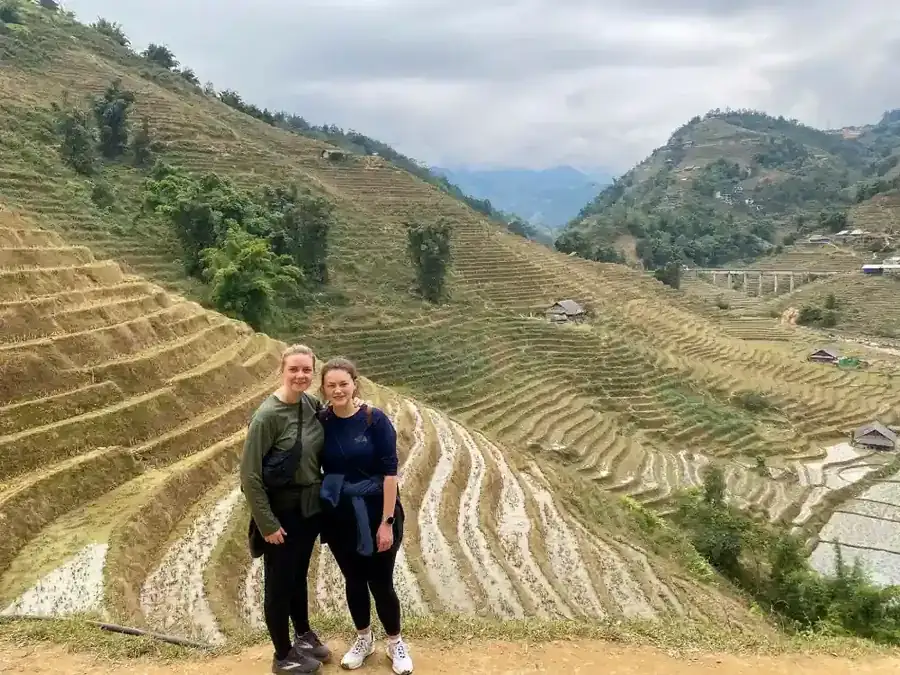
Lao Chai's visual identity is inseparable from its rice terraces — engineered slopes holding water for wet rice cultivation across monsoon seasons. From paths above the village, terraces stack toward the river in curves that photographers recognise instantly, yet each embankment represents weeks of family labour: stone reinforcement, mud packing, irrigation channel maintenance, and transplanting timed to rainfall patterns.
How terraces shape the village
Terraces are not scenery alone. They determine where houses sit — on ridges and terrace brows with field access — and where paths run — along embankment tops and between irrigation channels. Water buffalo plough fields where mechanisation cannot reach. Corn and vegetables fill secondary plots on steeper margins. Seasonal colour shifts define the calendar: mirror-bright flooded paddies at planting, emerald green at growth peak, gold before harvest. Region-wide seasons and photography: Sapa Rice Terraces.
Elevation and views
Lao Chai's mid-valley position produces some of the broadest terrace panoramas in Muong Hoa — wider than the enclosed feel of upper Y Linh Ho, more elevated than riverside Ta Van. Clear mornings after cold nights often bring the sharpest views, before cloud builds in warmer afternoon hours.
Damage to terraces — shortcutting across planted fields, dislodging embankment stones, or disturbing irrigation channels — directly harms household livelihoods. Established trekking paths exist because generations of farmers and walkers negotiated routes that minimise crop damage. Staying on them is a practical respect issue, not a bureaucratic rule.
Black Hmong Community
Lao Chai is a predominantly Black Hmong village — among the largest Black Hmong settlements in Muong Hoa Valley. The community maintains the indigo-dyed clothing tradition, hemp weaving, and livestock management that define Black Hmong identity across the Sapa region.
Women often wear indigo garments with silver jewellery; indigo traditions remain visible in cloth drying on porches, dye vats near homes, and market textiles sold in Sapa Town on rest days. Many Sapa Local Guides trekking guides are Black Hmong and grew up on these trails — their interpretation of village life, weather, and customs comes from lived experience rather than rehearsed commentary.
Lao Chai sees more trekking foot traffic than quieter upper or remote hamlets because it sits on the popular valley loop connecting Sapa to Ta Van. That visibility brings economic opportunity — guiding, homestay hosting, craft sales — alongside pressure from crowding, photography without permission, and children encouraged toward bracelet-selling on busy paths. Responsible visiting matters disproportionately here because visitor volume is high.
For deeper cultural context on language, history, textile production, and festivals, read the dedicated Black Hmong people guide. Lao Chai is one village expression of that broader culture — not the entirety of it.
Traditional Houses and Daily Life
Lao Chai homes are predominantly wooden structures on hillsides — post-and-beam frames with metal or tile roofs, cooking fires at the centre of family life, and livestock pens adjacent to or beneath living quarters. Houses spread along terraces rather than clustering in a compact village centre, producing the scattered, ridge-line settlement pattern visible from trekking paths above.
Daily rhythm follows agricultural and domestic cycles. Early mornings bring field work, animal feeding, and school departures. Midday heat may slow outdoor labour. Late afternoon returns focus on cooking, textile work, and market preparation. Tourism intersects this schedule — guides leading groups through, families hosting occasional homestay guests, artisans selling at trail-side stalls — without replacing farming as the economic foundation for most households.
Children walk significant distances on mountain paths to reach schools. Elders maintain textile skills, oral histories, and ritual knowledge. Younger adults may work as trekking guides or seasonal migrants to towns and cities, sending remittances while reducing village labour available for terrace repair.
Visitors who accept tea invitations or meal offers engage genuine hospitality traditions. Visitors who treat homes as open studios for photography without asking breach trust quickly — especially in a village as heavily transited as Lao Chai.
Farming and Local Economy
Lao Chai's economy rests on terrace rice cultivation supplemented by livestock, secondary crops, and increasingly tourism-related income. The seasonal farming calendar governs visible activity: planting floods terraces with water, green season fills slopes with young rice, harvest turns fields gold before threshing and drying grain near houses.
Water buffalo remain essential for ploughing. Pigs and poultry provide protein and market income. Forest margins supply firewood, foraged greens, and medicinal plants — knowledge held primarily by elders and shared within families.
Tourism income flows through several channels: local guiding fees, homestay payments, direct craft sales, and market vending in Sapa Town. Distribution is uneven — households on main paths benefit more visibly than those on quiet side ridges — a pattern common across Muong Hoa villages. Choosing private tours with local guides who employ and pay families directly supports more equitable benefit than anonymous mass tourism.
Lao Chai is not a craft-only or tourism-only village. Even on busy trekking days, field work continues. Interpreting what you see through that lens — farmers working rather than performing — prevents the common mistake of treating mountain agriculture as decorative backdrop.
Visiting Lao Chai Responsibly
High foot traffic makes responsible behaviour at Lao Chai especially important.
- •Stay on established paths — do not cut across planted terraces
- •Ask permission before photographing people; respect declines without argument
- •Buy crafts directly from makers when purchasing textiles; avoid aggressive bargaining on handmade work
- •Do not give candy or money to children on trails — it disrupts schooling and creates dependency
- •Carry out all litter, including wet wipes and food packaging
- •Walk at village pace near houses and school paths; reduce noise around livestock
Private trekking with local English-speaking guides — rather than self-guided wandering on unfamiliar paths — improves safety, interpretation, and household benefit. Sapa Local Guides operates with a minimum of two paying travellers and employs guides who grew up in these mountains.
Compare visiting norms with the Red Dao people guide if your route continues toward Giang Ta Chai or other Dao settlements downstream — cultural expectations differ even within the same valley.
Best Seasons to Visit
Lao Chai rewards visitors across seasons, but terrace appearance and trail conditions shift significantly through the year.
Spring (March–May)
Terraces green with new growth; comfortable walking temperatures; occasional rain. Clear mornings increase after winter mist — good for views toward Fansipan and upper Hoang Lien ridges.
Summer (June–August)
Lush emerald terraces; wettest months with slick paths and frequent cloud. Dramatic atmosphere when mist clears briefly; waterproof footwear essential.
Autumn (September–November)
Widely considered the finest balance — golden rice before harvest, clearer skies, crisp air. Most photogenic period for terrace colour; popular with photographers and first-time trekkers.
Winter (November–February)
Quieter trails; cold mornings with atmospheric mist; terraces may lie fallow or hold secondary crops. Dramatic cloud inversions on clear cold days; bring warm layers for valley walking.
Mountain weather changes hour by hour. Town-level forecasts understate valley fog and rain — trust your guide's daily assessment over generic apps.
Relationship with Muong Hoa Valley
Lao Chai functions as a central node in the Muong Hoa Valley network — geographically, culturally, and logistically.
Upstream, Y Linh Ho represents upper-valley Black Hmong life at higher elevation with steeper terrace walls and fewer day-trippers. Lao Chai marks the transition toward broader slopes and heavier foot traffic. Downstream, Ta Van introduces Giay communities, riverside scenery, and homestay traditions on lower valley floors. Further still, routes may reach Red Dao villages such as Giang Ta Chai — quieter, forested, and culturally distinct.
The Muong Hoa Valley guide explains this corridor as a whole — river geography, ethnic settlement patterns, and how trekking routes connect villages. Lao Chai is one chapter in that story, not the entire valley.
Within the Hoang Lien Mountains system, Lao Chai sits on the eastern massif flank below Fansipan — terrace agriculture in the cultural landscape zone rather than alpine forest or summit infrastructure. That position explains climate, crops, and why valley trekking here differs fundamentally from Fansipan cable car or remote ridge expeditions.
Practical Visitor Information
How trekkers typically reach Lao Chai
Most visitors arrive on foot from upper trailheads above Y Linh Ho or via paths descending from the Sapa basin rim — a core section of the Easy Muong Hoa Valley Trek and the Full-Day Muong Hoa Valley Trek. These are private day routes with local guides; Sapa Local Guides requires a minimum of two paying travellers. The Sapa Countryside Walking Tour explores quieter hamlets near town rather than the full Lao Chai corridor — useful context if you want village contact before committing to a full valley day.
Multi-day routes through Muong Hoa typically pass Lao Chai on the first day before continuing toward Ta Van homestays or deeper valley destinations — see the Complete Sapa Travel Guide for how products differ without overlapping every route detail here.
What to bring
Waterproof footwear, rain layers, sun protection, and a modest day pack suit valley walking year-round. Cash for direct craft purchases helps artisans more than card payments, which remain inconsistent in villages. Respectful dress — covered shoulders when entering homes — aligns with local expectations.
Photography
Terrace panoramas from established viewpoints are unrestricted; portrait photography of residents requires permission. Drone use may disturb livestock and residents — confirm with your guide and avoid flying low over working fields.
Fitness and duration
Reaching Lao Chai from upper trailheads involves sustained descent on stone and mud paths — moderate fitness suffices for day routes with guide support. The return to Sapa Town is typically by private vehicle from Ta Van or another valley endpoint rather than climbing back uphill on the same day.
Frequently Asked Questions
What is Lao Chai known for?
Lao Chai is known for expansive rice terraces, its large Black Hmong community, and its position on the central Muong Hoa Valley trekking corridor between Y Linh Ho and Ta Van.
Is Lao Chai the same as Muong Hoa Valley?
No. Muong Hoa Valley is the entire river valley system; Lao Chai is one village within it — among the largest and most visited Black Hmong settlements on standard trekking routes.
Which ethnic group lives in Lao Chai?
Lao Chai is predominantly Black Hmong. Lower downstream villages such as Ta Van are primarily Giay; Red Dao communities appear on forested side valleys and further routes described in the Red Dao people guide.
How far is Lao Chai from Sapa Town?
Lao Chai is reachable on foot within a half-day descent from upper valley trailheads — typically two to four hours of walking depending on route, pace, and weather. It is not a short stroll from town centre; most visits arrive via guided trekking from rim trailheads.
When is the best time to photograph terraces?
Late September through October often offers golden rice and clearer skies. March through May provides green terraces with manageable rain. Summer is lush but cloudy; winter is atmospheric but may hide distant peaks.
Can I visit Lao Chai without a guide?
Independent walking on popular paths occurs, but guided private trekking is strongly recommended for safety, cultural interpretation, and responsible household contact. Sapa Local Guides does not operate shuttle day-trips that treat the village as a drive-by attraction.
Does Lao Chai appear on Sapa Local Guides trekking routes?
Yes. Lao Chai is a central feature of the Easy Muong Hoa Valley Trek and the Full-Day Muong Hoa Valley Trek, among other multi-day products passing through Muong Hoa.
How does Lao Chai relate to Fansipan?
Lao Chai sits on the eastern Hoang Lien flank below Fansipan — terrace country with the summit massif visible on clear days from upper paths. Valley trekking and Fansipan summit visits are separate activities requiring different planning; see the Fansipan guide for summit-specific information.
Lao Chai endures because families continue farming these slopes — indigo cloth on porches, buffalo on paths, children walking to school beneath terraces that predate tourism. Visit with that reality in mind, and the village becomes more than a photograph: a place within a living mountain culture you can understand through patience, respect, and the guides who call this valley home.
Season planning: Best Time to Visit Sapa · September & October Harvest Season in Sapa · Wet Season & Fog Season in Sapa. Valley authority: Muong Hoa Valley.
Compare bookable routes: Lao Chai tours.
## Ready to book?
Ready to book? Explore our Book Hmong culture tour Sapa.
Möchten Sie Ihre eigene Geschichte schreiben?
Buchen Sie einen Sapa-Trek oder Homestay und erleben Sie das echte Bergleben.
Anfrage per WhatsApp