Sapa Local Guides · Vietnam · August 2026
Giay People of Sapa — Culture, Ta Van Village, Stilt Houses & Homestay Traditions
Who Are the Giay People?
The Giay — Giáy in Vietnamese — are a Tai-language ethnic minority group living in the lower valleys and riverside slopes of northwest Vietnam, including the Sapa region of Lao Cai Province. They belong to the broader Tai-Kadai language family, whose communities extend across northern Vietnam, southern China, and neighbouring highland regions. In Sapa, Giay families are most closely associated with lower Muong Hoa Valley — particularly Ta Van Village — where bamboo groves, stilt-house architecture, and riverside agriculture define daily life beneath the Hoang Lien Mountains.
Giay identity is expressed through housing design, wet rice cultivation on lower slopes, bamboo management, food traditions, and hospitality customs that emphasise shared meals and tea. Giay dress is generally less commercially visible to trekkers than the indigo textiles of the Black Hmong upstream or the embroidered jackets of the Red Dao in forested side valleys — culture here often reveals itself through architecture, farming rhythm, and household routine rather than market spectacle.
The Giay are not a single village or clan. Subgroups, dialect variations, and settlement histories exist across Lao Cai and neighbouring provinces. What unites Giay communities in the Sapa trekking landscape is geographic association with riverside land — warmer, greener, and lower in elevation than the terrace walls above Lao Chai and Y Linh Ho where Hmong families farm steep slopes.
For travellers, understanding who the Giay are converts a lunch stop in Ta Van into cultural context. The stilt houses, bamboo fences, and buffalo paths you walk through are part of a living community — not a generic "minority village" backdrop between Black Hmong terraces and Red Dao forest.
For broader trip planning — seasons, transport, homestays, budget, and how ethnic groups connect across Sapa — see The Complete Sapa Travel Guide, Homestay in Sapa — What to Expect, and Best Time to Visit Sapa.
History and Origins
Tai-speaking peoples have inhabited the river valleys and lower highlands of northern Vietnam for centuries. Oral histories among Giay communities in Lao Cai Province describe settlement along fertile watershed land — movement toward reliable water for wet rice, trade corridors linking mountain markets, and intermarriage with neighbouring groups including Hmong, Dao, and Tay families.
French colonial administrators documented Giay settlements in the Sapa region in the early twentieth century, noting stilt-house architecture, rice cultivation on valley floors and lower terraces, and distinct language from Hmong and Dao communities occupying higher or forested zones. Early maps placed Giay villages in the lower Muong Hoa corridor while Black Hmong settlements dominated upper slopes — a geographic pattern that persists in contemporary trekking routes.
The twentieth and twenty-first centuries brought roads, schooling in Vietnamese, fixed national borders, and tourism growth that reshaped economic life without erasing agricultural calendars, housing traditions, or hospitality customs. Many Giay families now combine farming with income from homestays, guiding support, and small-scale vending along busy valley paths — a dual economy familiar across ethnic minority regions of Vietnam.
Relations with neighbouring groups involve trade at Sapa markets, shared footpaths, intermarriage, and distinct land-use patterns at different elevations. Black Hmong families farm upper terraces; Red Dao communities occupy forested valleys downstream toward Giang Ta Chai; Giay households anchor riverside sections where water, bamboo, and milder temperatures favour their agricultural mix. The Sapa region is multi-ethnic by geography — coexistence without assimilation into a single culture.
Language
Giay language belongs to the Tai branch of the Tai-Kadai family — related to, but distinct from, Tay, Nung, and Thai languages spoken elsewhere in Vietnam. Dialect variation exists between Giay communities in Lao Cai and those in other provinces; Sapa-area Giay speech reflects local settlement history and contact with Vietnamese, Hmong, and Dao neighbours.
Most Giay adults in the Sapa region speak Vietnamese for market trade, schooling, and official business. Hmong and Dao languages may be understood partially through daily contact on shared trails, but Giay remains the household language for many families — especially elders — in Ta Van and neighbouring hamlets.
Travellers rarely need Giay vocabulary for a standard trek, but a greeting learned through your guide — or a simple thank-you after a homestay meal — signals respect. Guides who grew up in the valley often translate between Giay hosts and English-speaking guests during homestay evenings, bridging conversation that would otherwise stall at language boundaries.
Language loss through schooling and migration affects younger generations, as in many minority communities. Homestay and guiding income creates reasons for young Giay adults to remain in villages — one way tourism can support language and custom continuity when arrangements pay families directly rather than through anonymous intermediaries.
Traditional Houses
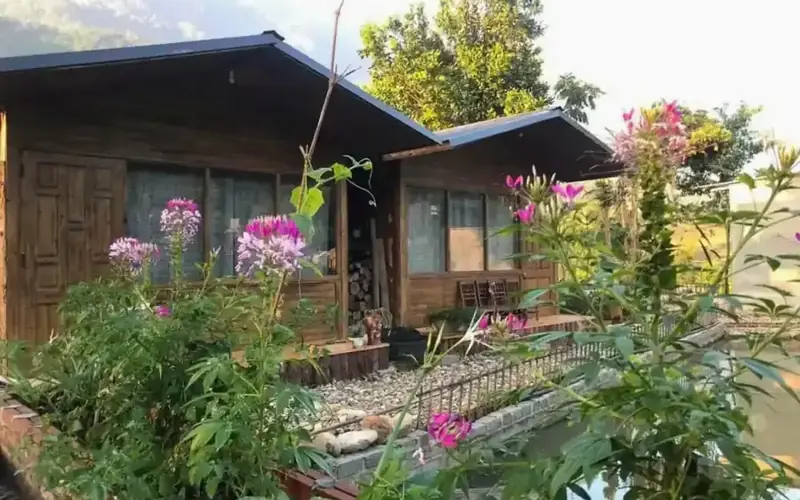
Giay homes in the Sapa region are characteristically stilt houses — wooden structures raised above ground on posts, with living space on the upper level and storage, livestock pens, or workspace beneath. This form suits riverside humidity, seasonal flood risk on lower valley floors, ventilation in warmer temperatures, and protection from ground moisture during monsoon months.
Construction combines timber framing, bamboo wall panels, and metal or tile roofs on most modern buildings — though older auxiliary structures may retain thatch. Houses orient toward valley views and afternoon sun where terrain allows. Stone or concrete footings stabilise posts on steep sites. Bamboo harvested from managed groves supplies fencing, flooring, and temporary structures.
The main living level typically centres on a kitchen and gathering space — fire for cooking, heat in cooler evenings, and social heart of the household. Sleeping areas may be partitioned or on raised platforms. Guest mattresses for homestays occupy the same building — simple bedding, blankets, mosquito nets — within working family space rather than purpose-built hotel wings.
Livestock — pigs, poultry, sometimes buffalo — occupy ground level or nearby sheds. The proximity is practical for mountain husbandry and predation risk, though it surprises urban guests unaccustomed to animal sounds beneath the floorboards.
Compare housing with Black Hmong post-and-beam homes on upper slopes — often ground-level or partial stilt without the pronounced raised form — and Red Dao wooden houses on forested mid-slopes. Architecture signals ethnic identity and ecological adaptation as clearly as clothing on many trekking routes.
Agriculture and Rice Farming
Giay agricultural life centres on wet rice cultivation, riverside vegetables, bamboo management, and livestock — a mix suited to lower Muong Hoa elevations where water access is more reliable than on the steepest upper terraces farmed by Black Hmong families.
Rice terraces and fields
Rice remains the staple crop. Giay families maintain embankments on lower and mid-slope terraces, manage irrigation from the Muong Hoa River and tributary channels, and follow monsoon calendars shared across the valley — planting floods, green growth, golden harvest — even where crop timing differs slightly from upper Hmong slopes.
Terraces here are livelihood infrastructure, not scenic backdrop. Cutting across planted fields, dislodging embankment stones, or flying drones low over working farmers shows disregard for labour embedded in every curved wall. Seasonal appearance shifts mirror the wider valley: mirror-bright water at planting, emerald green in summer, gold before harvest, quieter fallow periods in winter.
Bamboo, vegetables, and livestock
Bamboo groves line watercourses and household margins — harvested for construction, fencing, basketry, and culinary use. Vegetable gardens sit near homes where soil and water permit. Water buffalo plough fields where slopes allow; pigs and poultry provide protein and market income.
Lower elevation produces slightly milder temperatures and longer growing seasons than upper Black Hmong territory — one reason Giay and Hmong land use complement rather than compete within the same watershed. Trade at Sapa markets connects Giay produce to town economies alongside Hmong textiles and Red Dao herbal products.
Daily Life
Giay family structure traditionally emphasises extended household cooperation — grandparents, parents, and children sharing agricultural tasks, childcare, and household maintenance. Gender roles remain visible in daily division of labour, though tourism and homestay hosting have introduced new employment patterns, especially for women preparing guest meals and men supporting guiding logistics.
Daily rhythm follows agricultural cycles: early field work, animal feeding, school paths active mid-morning, cooking and craft work in afternoons, early nights in quieter seasons. Children attend village schools when accessible, often walking paths shared with trekkers — a overlap that demands reduced speed and noise near households.
Elders hold knowledge of bamboo cultivation, irrigation repair, food preservation, and calendar festivals. Younger generations may migrate seasonally to towns, though homestay income creates reasons to remain for some families.
Meals centre on rice, vegetables, pork, foraged greens, and bamboo shoots — home cooking over fire rather than restaurant service on typical homestay nights. Guests who accept food offerings engage a hospitality tradition; guests who treat meals as insufficient relative to urban standards misunderstand the context.
Tourism intersects this schedule without replacing it. Homestay hosts prepare guest meals around their own family cooking; guides lead groups through while neighbours continue farming. Income distribution is uneven, as in Lao Chai: families on main paths and homestay networks benefit more visibly than households on quiet side ridges.
Food Traditions
Giay cuisine in the Sapa region reflects valley agriculture — rice as foundation, pork and poultry as protein, vegetables and foraged greens as daily accompaniment, bamboo shoots as seasonal highlight.
**Staple meals:** Boiled or steamed rice with stir-fried vegetables, soups flavoured with ginger and herbs, and grilled or stewed pork. Meals are communal — shared dishes on the table, guests seated with the family rather than served separately as in restaurants.
**Bamboo shoots:** Harvested seasonally from managed groves, prepared fresh or preserved. Bamboo appears in soups and stir-fries — a flavour distinct to lower valley cooking that homestay guests often remember.
**Rice wine:** Homemade rice wine may appear in small cups during evening meals — hospitality offering rather than bar service. Declining entirely can feel abrupt; sipping a little or explaining politely through your guide works better than refusing everything.
**Tea:** Offered on arrival and between meals — accept or decline graciously. Tea precedes conversation in Giay hospitality custom.
**Fish and river food:** Where access permits, river fish supplements diet — less dominant than rice and pork but part of riverside livelihood.
Food traditions connect directly to homestay experience. The Sapa Local Homestay Experience and the 2-Day Trek & Local Homestay place guests with Giay families in Ta Van under arrangements where meals are part of cultural exchange — not catering detached from household routine.
Clothing and Textiles
Giay clothing is less uniformly distinctive to casual trekkers than Black Hmong indigo dress or Red Dao embroidered festival garments. Daily work clothes resemble practical mountain wear — indigo or dark cotton, simple cuts suited to field labour — without the commercial visibility of Hmong textile markets.
Traditional festival dress exists — brighter colours, embroidered panels, and accessories whose details vary by subgroup and occasion — but travellers more often encounter Giay culture through housing and food than through costume on the trail. Textile and craft traditions persist in households: weaving, basketry from bamboo, and food preparation methods passed within families.
Markets in Sapa Town include Giay vendors selling produce and crafts alongside Black Hmong and Red Dao traders. Purchasing directly from makers supports household income more reliably than buying from resellers who did not produce the work.
Photographing people in daily dress still requires permission — lack of elaborate costume does not reduce the person to a prop. Compare textile depth with the dedicated Black Hmong People guide and Red Dao People guide for neighbouring groups whose clothing traditions dominate trekking photography.
Festivals and Beliefs
Giay spiritual life combines ancestor veneration, household altars, and calendar festivals tied to agricultural cycles. Practices vary between villages and lineages; outsiders should assume ceremonies are private unless a host family explicitly invites observation.
New Year celebrations — aligned with lunar calendar traditions shared across Tai-speaking communities in the region — involve special foods, ancestor offerings, social visiting between households, and rest from field labour. Weddings require extended negotiation between families, gift exchange, and ritual meals. Funerals follow protocols for guiding the deceased and supporting mourners over days.
Spirit beliefs attach to natural features — water sources, grove margins, threshold spaces — reflecting a worldview in which landscape and household are spiritually active. Disrespect at sacred sites, intrusive photography during rituals, or loud behaviour at ceremonies causes genuine offence.
Travellers rarely plan visits around Giay festivals unless homestay arrangements are made through operators with village relationships. Seasonal timing for trekking and homestays — including harvest activity and planting floods — is covered in the Best Time to Visit Sapa guide and the Ta Van Village guide.
Homestay Culture
Giay communities are among the most important homestay hosts in the Sapa trekking landscape — especially in Ta Van, where lower valley location, road access for vehicle pickup, and established hosting relationships make overnight stays practical on two-day routes.
Homestay accommodation places travellers in working households — simple mattresses, shared blankets, mosquito nets, and bathroom facilities that may be basic by urban standards but reflect genuine family hospitality. Authentic homestays are working homes, not hotel replicas — a distinction covered in depth in Homestay in Sapa — What to Expect.
Giay hospitality traditions emphasise welcoming guests with tea and food — offers that carry social weight. Shoes often come off at doorways; seating arrangements may follow age and gender customs your guide can explain. Evening social life centres on the kitchen, the fire, and conversation — or early sleep before tomorrow's walk.
The Sapa Local Homestay Experience is hosted by Giay families in the Ta Van area under direct arrangements with Sapa Local Guides rather than anonymous booking pools. The 2-Day Trek & Local Homestay typically spends its overnight in Ta Van or the immediate Giay hamlet network after walking through upper Muong Hoa on day one.
Custom homestay combinations — extended stays, quieter hamlets, or multi-village routes — can be discussed through Private Sapa Expeditions when standard products do not match your interests.
Homestays are not hotels. Meals arrive when ready; sleeping arrangements follow household capacity; hot water may be limited. Guests who engage conversation through their guide, accept food graciously, and avoid treating family kitchens as photo studios generally receive warmth that transactional tourism cannot replicate.
Ta Van — The Best-Known Giay Village
Ta Van Village is the primary Giay settlement anchor on the most walked corridor in Sapa — the route that descends from upper Black Hmong terraces through Lao Chai into lower riverside country. For many travellers, Ta Van is the first place Giay culture becomes tangible: stilt houses, bamboo groves, the sound of the Muong Hoa River, and homestay lights at dusk.
Ta Van is not interchangeable with "Giay people" as a whole — it is one village expression of a broader culture distributed across lower valleys in Lao Cai Province. But within Sapa tourism geography, Ta Van functions as the reference point: lunch stop on day treks, vehicle pickup endpoint, overnight base on two-day routes, and gateway toward Red Dao forest country downstream at Giang Ta Chai.
Understanding Ta Van as a named place within a multi-ethnic valley prevents treating it as a generic stop between Hmong terraces and Dao waterfall paths. The dedicated Ta Van Village guide covers landscape, seasons, responsible visiting, and practical logistics in place-specific detail — this Giay people guide provides the cultural context that village page assumes.
Relationship with Muong Hoa Valley
Giay communities occupy the lower and middle-lower sections of Muong Hoa Valley — the great river corridor that drops eastward from Sapa Town into the Hoang Lien massif. Geographic position shapes everything: warmer temperatures, riverside humidity, bamboo resources, and footpath connections to both upper Hmong villages and downstream Red Dao settlements.
The standard trekking sequence — upper Black Hmong terraces at Y Linh Ho and Lao Chai, cultural transition at Lao Chai crossroads, Giay riverside life at Ta Van, optional continuation toward Red Dao Giang Ta Chai — is one of the most instructive multi-ethnic walks in northern Vietnam. Elevation change within a single day explains why groups with distinct languages, housing styles, and crops live side by side without merging into one culture.
Giay families depend on valley infrastructure shared with neighbours: irrigation channels, market paths, school routes, and road access developed over decades of multi-ethnic settlement. Tourism pressure concentrates on the Lao Chai–Ta Van corridor — economic opportunity for Giay homestay hosts alongside crowding, litter, and photography conflicts that responsible visiting must address.
The Muong Hoa Valley guide covers corridor-wide geography, seasons, and trekking context. This guide explains who lives on the lower slopes and why their culture looks different from communities above and below on the same watershed.
Differences from Black Hmong and Red Dao
Neighbouring does not mean interchangeable. Three contrasts help travellers interpret a single valley day.
Giay and Black Hmong
Black Hmong communities dominate upper Muong Hoa — Lao Chai, Y Linh Ho, and hamlets on steep terrace walls. Hmong identity centres on indigo hemp textiles, upper-slope rice terraces, and Hmong language. Housing tends toward ground-level or partial-stilt wooden structures on hillsides rather than the pronounced riverside stilt form common among Giay families.
Elevation separates daily rhythm: upper villages experience cooler nights, earlier mist, and steeper field access. Black Hmong textile tradition is commercially visible on trails and markets; Giay culture often expresses through architecture and food. Deep dive: Black Hmong People guide.
Giay and Red Dao
Red Dao communities occupy forested side valleys and downstream sections toward Giang Ta Chai — embroidery, herbal medicine, and red headdress traditions define Red Dao material culture. Red Dao villages often sit on mid-slopes with forest access rather than open riverside farmland.
Herbal baths and elaborate stitched festival dress characterise Red Dao tourism associations; Giay homestay hospitality and bamboo-stilt housing characterise Giay associations. Deep dive: Red Dao People guide.
Practical implication for visitors
Customs, photography norms, and homestay expectations differ by group even within one valley walk. Guides who grew up in specific communities translate those differences — another reason private tours with local guides outperform anonymous mass groups on cultural routes.
Responsible Visiting
Tourism has brought income, employment, and visibility to Giay communities — alongside pressure: trail crowding on the Lao Chai–Ta Van corridor, intrusive photography, children directed toward bracelet sales on busy paths, and uneven benefit when intermediaries absorb homestay payments.
Practices that support Giay communities rather than extract from them:
- •Book private tours with local guides employed directly — not anonymous mass groups
- •Choose homestays where hosts are paid directly through operators with village relationships
- •Ask permission before photographing people, homes, and meals
- •Stay on established paths; do not enter houses uninvited
- •Buy crafts and produce from makers at fair prices; avoid aggressive bargaining on handmade work
- •Carry out all litter; do not distribute candy or money to children on trails
- •Respect homestay simplicity — complaints about basic facilities misunderstand the context
- •Read [Homestay in Sapa — What to Expect](/stories/homestay-in-sapa-what-to-expect) before overnight stays
Sapa Local Guides operates with a minimum of two paying travellers, working through personal relationships with Giay, Black Hmong, Red Dao, and Tay families. Custom cultural routes — extended homestays, multi-village combinations, or quieter hamlets — can be arranged through Private Sapa Expeditions.
Compare responsible norms with the Ta Van Village guide for place-specific traffic patterns and the Black Hmong People guide for upper-valley context on the same trekking day.
Visiting Giay Communities Respectfully
Respect converts ethical intention into behaviour on the ground.
Prepare before walking
Read the Muong Hoa Valley guide to understand how Ta Van fits into trekking geography. Read the Hoang Lien Mountains guide for elevation, weather, and landscape context. Read Best Time to Visit Sapa for seasonal conditions that affect riverside paths differently from upper ridges.
On the trail
Walk at village pace when passing houses and school paths. Greet adults briefly; follow your guide's lead on language and customs. Dogs guard properties — give space. Buffaloes on paths have right of way.
If invited for tea or a meal, accept or decline graciously. Remove shoes when entering homes if residents do. Do not assume open terraces or doorways invite entry without invitation.
Photography and commerce
Portrait photography requires explicit permission even when dress is not ceremonial. Craft purchases support household income more reliably than tips or unsolicited gifts.
What Sapa Local Guides offers
Sapa Local Guides provides private trekking and homestay experiences through Giay territory — valley routes on Sapa Trekking Tours, dedicated Giay homestays on the Sapa Local Homestay Experience, and two-day combinations on the 2-Day Trek & Local Homestay. We do not treat Giay villages as open-air museums; guides facilitate introductions, translate conversations, and manage logistics while families continue daily life around guests.
Frequently Asked Questions
How many Giay people live around Sapa?
Population figures vary by census boundaries and administrative definitions. Giay communities in the Sapa trekking landscape concentrate in lower Muong Hoa Valley — Ta Van and neighbouring hamlets — rather than living in a single town. Giay settlements also exist elsewhere in Lao Cai Province beyond the standard tourist corridor.
What language do the Giay speak?
Giay speak a Tai-Kadai language distinct from Hmong and Dao. Most adults also speak Vietnamese for market and official business. Your guide translates during homestay visits when needed.
What is the difference between Giay and Black Hmong?
Different languages, housing traditions, settlement elevations, and material culture. Black Hmong identity centres on indigo hemp dress and upper Muong Hoa terraces; Giay identity centres on riverside stilt houses, bamboo agriculture, and lower valley farming. See the Black Hmong People guide for comparative detail.
What is the difference between Giay and Red Dao?
Red Dao communities emphasise embroidery, herbal medicine, and forest-valley settlement patterns — often downstream toward Giang Ta Chai. Giay communities emphasise riverside agriculture and homestay hospitality in Ta Van. See the Red Dao People guide.
Which village should I visit to meet Giay people?
Ta Van is the best-known Giay village on standard Sapa trekking routes — covered in the Ta Van Village guide.
Can I stay overnight with a Giay family?
Yes, through guided homestay products — including the Sapa Local Homestay Experience and the 2-Day Trek & Local Homestay. Read Homestay in Sapa — What to Expect first.
When is the best season to visit Giay villages?
September through November offers golden rice and clearer skies; March through May provides green terraces with manageable rain. Lower Ta Van is slightly milder than upper valley villages. Month-by-month detail: Best Time to Visit Sapa.
Do Sapa Local Guides operate Giay homestays?
Yes. Giay families in the Ta Van area host guests on homestay products under direct arrangements with Sapa Local Guides — not anonymous booking pools.
The Giay people anchor the lower Muong Hoa Valley — their stilt houses, rice fields, and homestay kitchens predate tourism and will outlast any travel trend. Visiting with respect, learning before photographing, and choosing operators who employ local families turns a walk through Ta Van into something closer to genuine cultural understanding.
**Place authority guides**
Ta Van · Muong Hoa Valley · Lao Chai · Y Linh Ho · Giang Ta Chai
Want to create your own story?
Join a Sapa trek or homestay and live the real mountains.
Enquire on WhatsApp